Every company has at least one task that repeats every single day, eats up time and requires no intelligent decision from whoever performs it. Copying data from one system to another. Answering the same question for the fifth time on WhatsApp. Manually building a spreadsheet that already exists somewhere else. That isn't work — it's friction.
Process automation isn't about robots replacing people. It's about taking off your team's hands the tasks that a well-defined rule can handle on its own, so that human time is left for what truly requires judgment: serving customers well, selling, deciding.
What process automation is (and what it isn't)
Automation isn't buying expensive software and expecting it to solve everything. It's identifying a sequence of repetitive, predictable steps — and having the system run that sequence on its own, without depending on someone remembering to do it.
A simple example: when a lead fills out a form on the website, it should automatically land in a CRM, receive a confirmation message and trigger a notification to the sales team. If today that depends on someone manually copying and pasting the contact, there is no automation — there's a digital process doing the work of a manual process, just slower to reveal that it's broken.
Signs your company needs to automate something now
Some symptoms show up before any technical diagnosis:
- A lead takes hours (or days) to get a first response
- The same information is typed into more than one system
- Someone on the team spends part of the day copying data between spreadsheets, emails and WhatsApp
- Errors happen because a step "forgot" to be done
- Growing means, in practice, hiring more people to do the same manual task at higher volume
If two or more of these are true today, there's a quick-return automation waiting to be implemented.
Where automation delivers real results
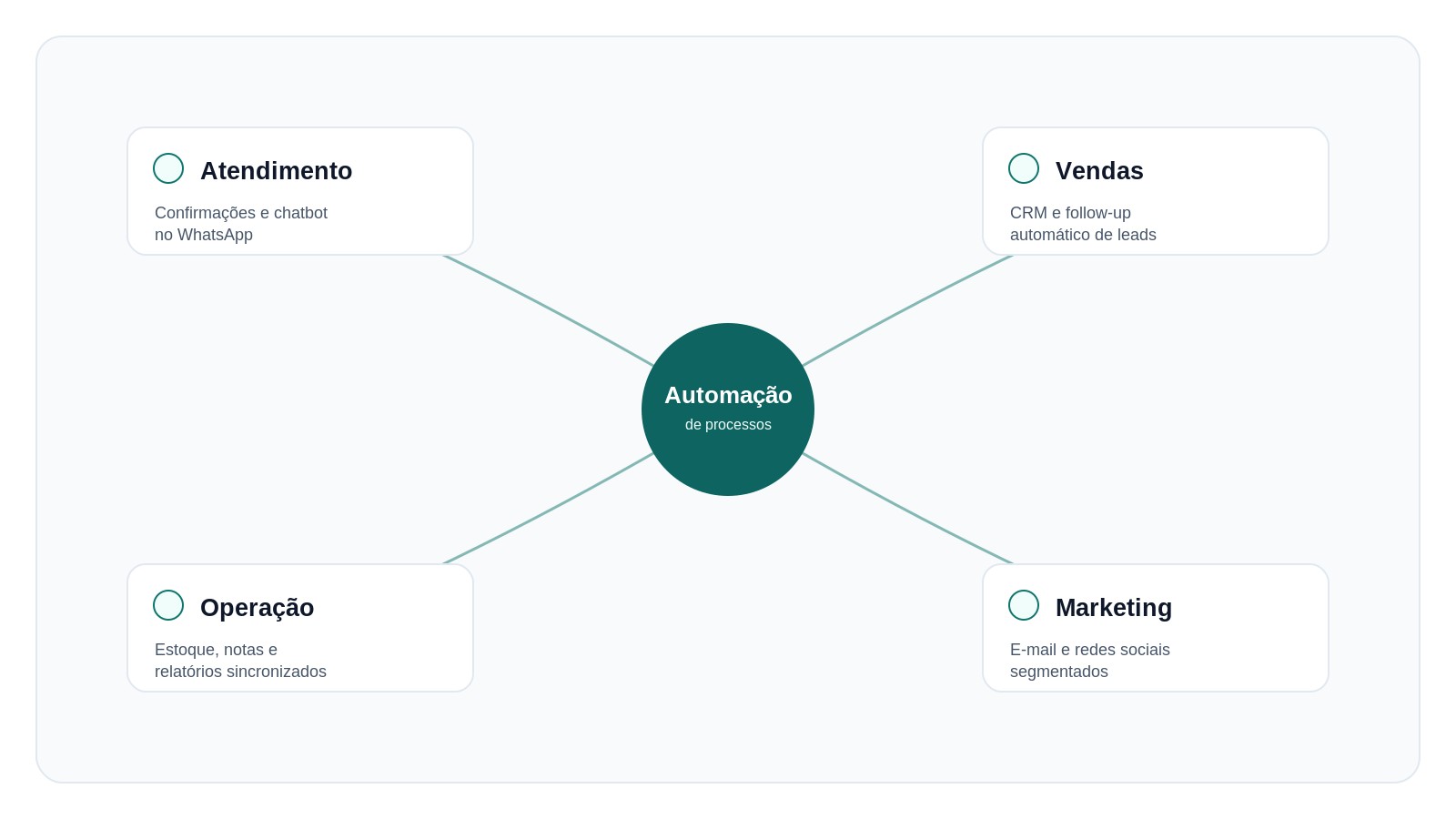
Customer service
Appointment confirmations, answers to frequently asked questions, routing conversations to the right team — all of this can run via the WhatsApp Business API, a chatbot or an email flow without anyone having to be on call all day.
Sales
A lead that arrives through the website, Instagram or a referral should automatically follow a sequence: CRM registration, first contact message, scheduled follow-up if there's no response. Sales are lost not because of a lack of customer interest, but because of delays and forgetfulness on the company's side.
Internal operations
Issuing invoices, updating inventory, generating the weekly report, syncing financial and operational systems. Every integration that eliminates a "do it manually every week" task gives time back for strategic decisions.
Marketing
Email lead nurturing, scheduled social media posts, automatic contact segmentation by behavior. Marketing that depends on someone remembering to send a campaign manually is marketing that only happens when there's spare time — in other words, almost never.
What the numbers show
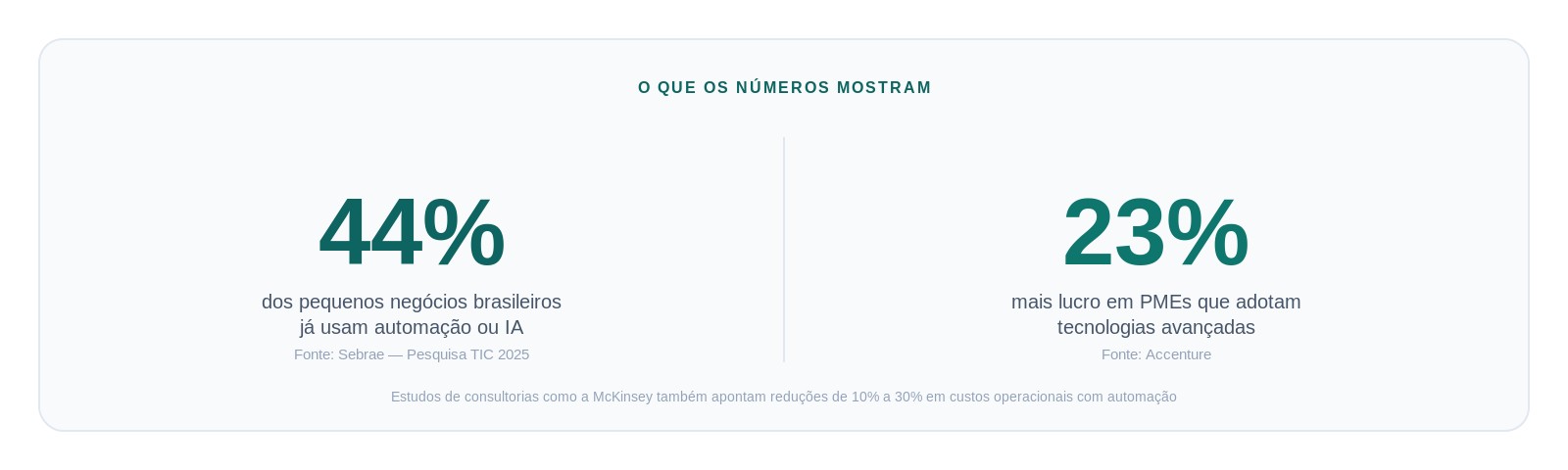
Automation is no longer a big-company trend. According to the TIC 2025 Survey — Digital Transformation in Small Businesses (Sebrae), 44% of Brazilian small businesses already use some AI or automation solution in their operations. An Accenture study shows that SMBs that adopt advanced technologies have 23% more profit than those that don't. Consulting firms like McKinsey also point to 10% to 30% reductions in operating costs from automation, varying by process.
The pattern is consistent: automation isn't a cost, it's the difference between growing by hiring and growing with the team you already have.
Where to start — a 4-step roadmap
1. Map the process before automating it. Write down the exact step-by-step of how a task happens today, from start to finish. Automating a poorly designed process only makes the error happen faster.
2. Choose the highest-volume task, not the most complex one. Automating something that happens 200 times a month pays off much sooner than automating something rare and complicated.
3. Connect the systems you already have before buying a new one. Often automation doesn't require switching tools — it requires integrating the ones the company already uses (website, CRM, WhatsApp, spreadsheets, ERP) via API or webhook.
4. Measure before and after. Time spent, number of errors, customer response time. Without a baseline number, it's impossible to know whether the automation is working or just changing where the work happens.
Common mistakes when automating
- Automating a broken process. If the manual process is already confusing, automating it only formalizes the confusion.
- Trying to automate everything at once. The fastest return comes from solving one bottleneck at a time, validating, and moving on to the next.
- Choosing tools that don't talk to each other. Automation depends on integration. Five isolated tools create five data silos, not an automated process.
- Forgetting the human factor. Good automation is invisible to the customer — they feel well served, not like they "talked to a robot."
Conclusion
Process automation isn't about replacing people with systems. It's about giving human time back to what only a human does well: serving with attention, selling with strategy, deciding with context. The companies that grow without bloating their payroll are, almost always, the ones that first organized and then automated what they were already doing.
The first step isn't choosing a tool. It's mapping where your team's time is being spent on tasks that a well-defined rule could handle on its own.
If you recognized at least one of the signs in this article in your operation, now is the time to map the automations and integrations that would make sense for your business — whether that's connecting your website to a CRM, automating customer service on WhatsApp or integrating systems that don't talk to each other today.