
"We need an app" is one of the most common phrases when a company decides to invest in technology — and most of the time, it's the wrong answer to the right problem. Not because apps are bad, but because the question was asked backwards: they picked the solution first, then went looking to see whether it solved anything.
The decision between a website and an app isn't about which one looks more modern. It's about what your business actually needs to do.
What a website solves (and solves well)
A corporate website or a well-built landing page covers practically every communication and conversion need: presenting the company, showing products and services, capturing leads, selling directly, showing up on Google. It works on any device, requires no download, and can be updated instantly without waiting on app store approval.
For the vast majority of small and medium-sized businesses, a well-made responsive website meets the real need: being found, conveying trust and turning visitors into customers.
What only an app solves
Some needs a website can't meet — not because of a technical limitation, but because they're functions that require what only a native app delivers well:
- Working without an internet connection
- Deep access to the device's camera, GPS or sensors
- Sending native push notifications
- Storing each user's data and preferences in a dedicated environment, with frequent use
- Running an operation that the same user repeats daily (not just consuming content)
If your business depends on something from this list, an app stops being a luxury and becomes a work tool.
How much each option costs
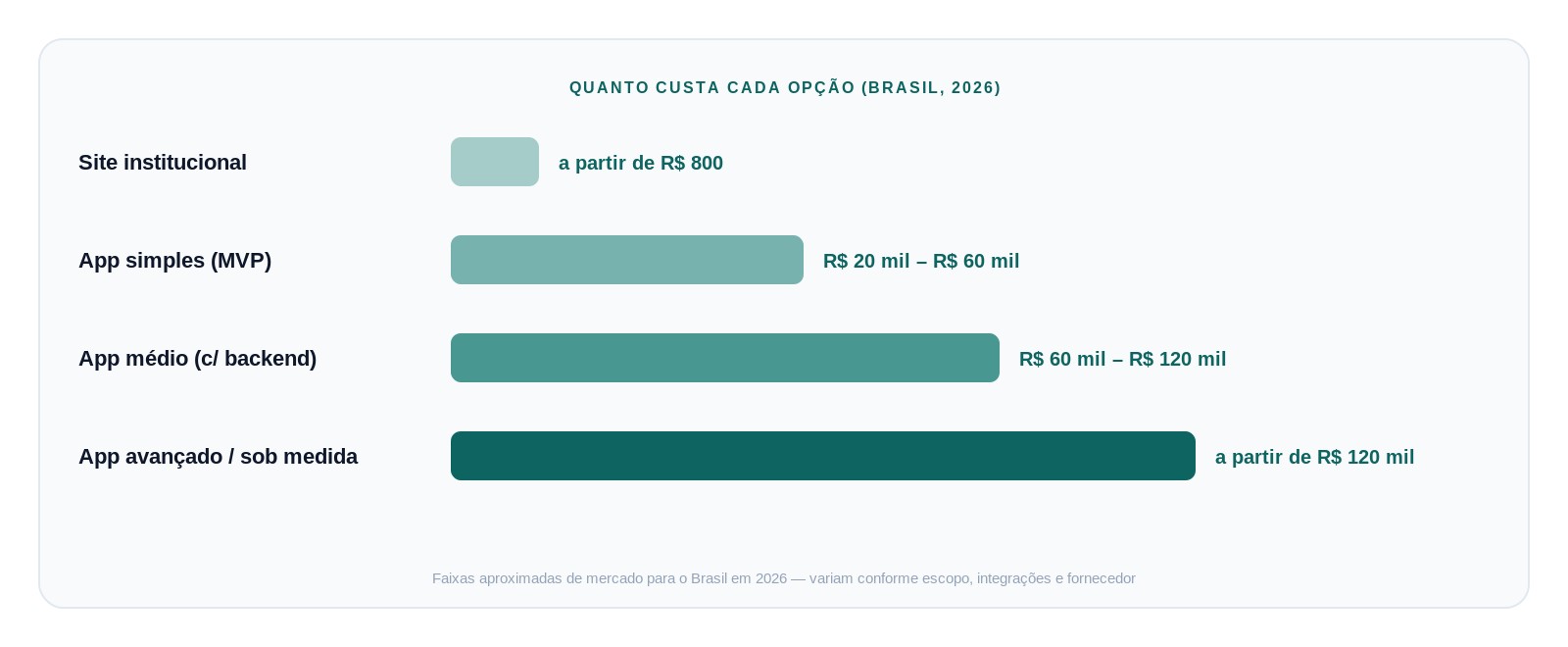
The difference in investment between the two options is usually the factor that weighs most in the decision. In the Brazilian market in 2026, a well-made corporate website starts at a few hundred reais and grows with complexity. A simple app (an MVP with a few screens), on the other hand, starts at much higher values and climbs quickly as a custom backend, integrations and features like push notifications come in.
That doesn't mean an app is "too expensive" — it means the investment only pays off when the functionality truly requires an app. Spending on something a website would solve is money badly allocated, no matter the amount.
The right question: not "website or app," but "what does my business need to do?"
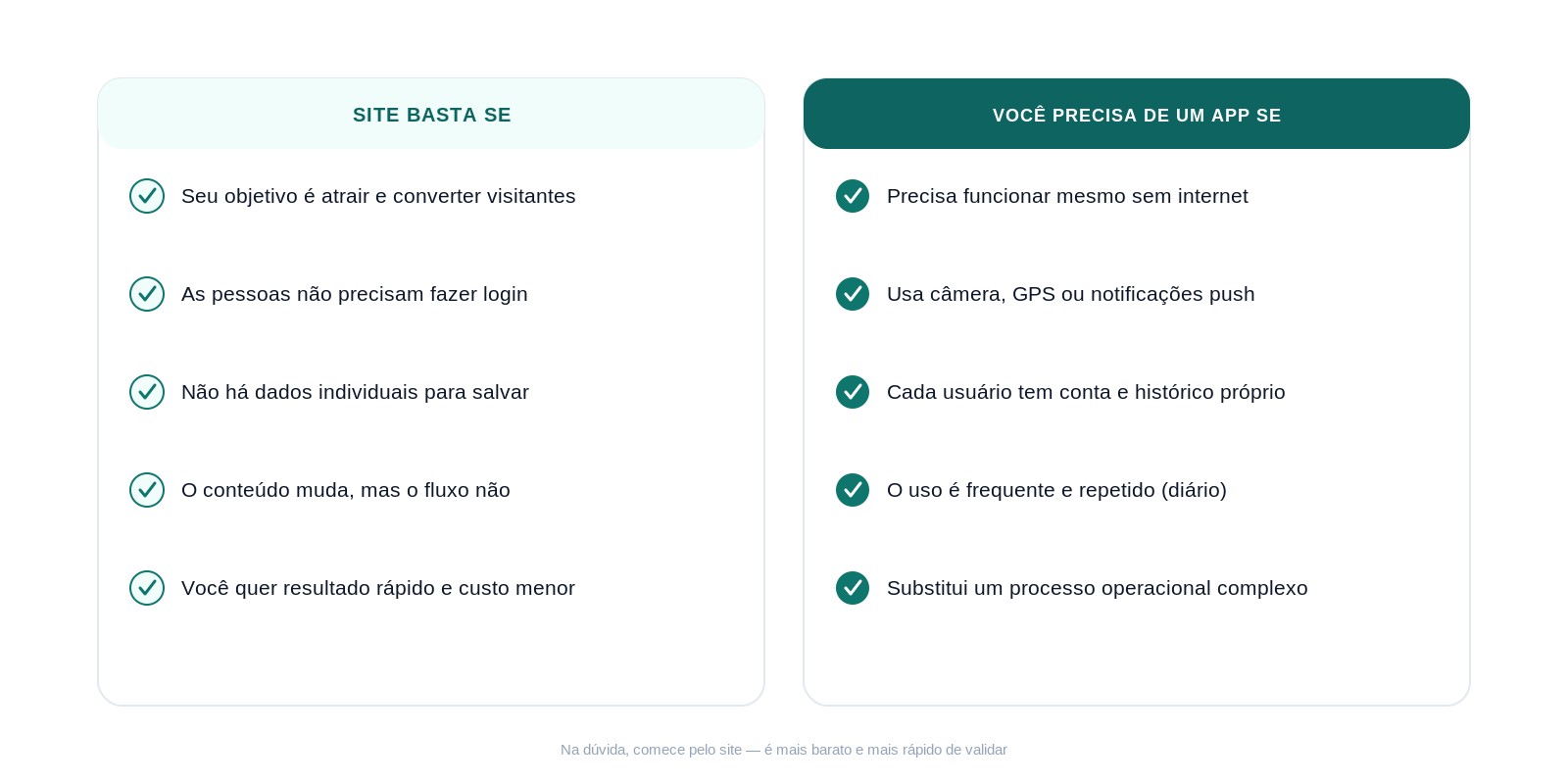
Instead of asking which solution seems more complete, it's worth mapping the actual behavior your business needs to enable. Businesses that live off attracting, informing and converting — the vast majority of service providers, retail shops and B2B companies — solve this with a website. Businesses that depend on recurring use, per-user personal data or native phone features usually need an app.
It's worth noting: a considerable share of the time people spend on their phones happens inside apps, not in the browser — that's real. But it doesn't mean every company needs to compete for space on the customer's home screen. It only means that, when an app makes sense, it tends to generate more engagement than an equivalent website.
The middle ground few people consider: PWA
Between the traditional website and the native app there's a third option: the Progressive Web App (PWA) — a website that behaves like an app. It can be "installed" on the home screen, works partially offline and sends notifications on a good share of devices, without going through the app stores and at a cost closer to a website than to a full native app.
It doesn't replace an app when you need advanced native features, but it covers many of the cases where a company wants to "look like" an app without paying the price of one.
Common mistakes in this decision
- Building an app before validating the idea with a simpler website or MVP. Validating cheaply first avoids spending big on something the market doesn't confirm.
- Choosing an app for status, not need. "Having an app" doesn't produce results on its own — solving a real problem does.
- Ignoring ongoing maintenance. A native app requires constant updates to keep up with Android and iOS; a website requires far less structural maintenance.
- Thinking a website "doesn't count" as a serious digital presence. A fast, well-structured website with a good experience is, for most businesses, more effective than an app that goes underused.
Conclusion
Websites and apps don't compete with each other — they solve different problems. The right decision starts by mapping what your business needs to do, not by picking the option that seems most impressive. When in doubt, the cheapest and fastest path to validate is almost always the website — the app comes later, when the specific need truly shows up.
If you're torn between building a website or an app, now is the time to map what your business really needs before investing. [Talk to me](/contact) to define the right solution for your case, or see how this was decided in [real projects](/projects).